The App I Built Instead of Reading (That Now Helps Me Read)

I got the idea from a recent Hard Fork episode about “vibe coding.” Everyone seems to be using AI to build software by describing what you want rather than writing code yourself–something beyond my current skill set, until now. But what to code?

I have a love/hate relationship with Libby, the well-crafted app from Overdrive that lets you get e-books from your local library. My pain point: I’d browse NPR’s “Books We Love” list, find something interesting, check whether it’s available at Brooklyn Public Library, discover it has a 12-to-24-week wait, add it to my hold list, and then weeks later when it finally arrived have no idea why I’d wanted it in the first place. The context was gone.

So I built an app to solve it. In a long afternoon, on a holiday. Without knowing how to code.

I mean, I’ve made some things. FileMaker databases to track community organizations back in the day. Some DOS batch files. Simple web pages and maybe a form here and there. A WordPress site. But nothing like this. This is a web app with filtering, a chat interface powered by Claude and integration with multiple data sources. When I managed a mobile app team at Consumer Reports, a minimum viable product like this would have been at least one sprint or a couple weeks of work. Here it was a few hours of me talking to Claude Code, and I had fun doing it. All of a sudden the gap between what I had envisioned and reality was passable.

I named it “Great Reads Now!” and it does one thing well: shows me great books that are available right now at my library. No waiting, no forgetting why. It pulls titles from NPR’s “Books We Love,” the New York Times Best Books list, and AudioFile’s best audiobooks. I can filter by genre, toggle between ebooks, audiobooks, and print, and hit “Spin Again” to get three random picks. Initially I had it show everything but I found the number of options overwhelming, so three it was.

But what if I wanted something more personal? So I added a chat feature. I can tell it “I just finished something heavy, want something lighter” and it recommends from the available pool. That’s an interaction Libby might have but doesn’t yet — a conversation instead of a long list of thousands of available titles which may or may not be to my liking.

I also added print book availability and a ThriftBooks search for when I’d rather own it and scribble in the margins. When I showed a friend — a Python user who builds math problem sets for his classes — he asked for a copy. Said he’d actually use it. So with Claude Code’s help it’s now on my very first GitHub repository: github.com/ted-bongiovanni/npr-bpl-checker

What it cost

I’ve led software teams that build apps. I know roughly what this would have cost: a UX person, a developer, a PM — three people, two weeks, real money in loaded labor costs, plus all the coordination overhead. I did it with a Claude account and $5 in API credits for the chat interface.

The value is in knowing what to build and why. That said, you might have to go through the process of making it to realize if it’s worth the effort. For me, this was more of a learning project–what can I do with my imagination and these new tools?

The app works because I had identified a real, if minor pain point. Because I’d lived with the Libby frustration for years, I had a good sense of which features mattered (the “show me three” randomizer) and which were noise (I thought Goodreads ratings would be handy, but they cluster so tightly they’re useless for decisions — I made them a toggle, a feature I’ll likely deprecate).

What this isn’t

It’s not production software. My API (Application Programming Interface) key is probably in the wrong place. The data refresh is manual. If I wanted to share it publicly, I’d need a backend, user accounts, rate limiting. The gap between “works for me” and “works for everyone” is real.

But for me and my geeky friends? It is real software. It runs. It solves a problem. And I understand the shape of it well enough to keep adding features.

The trap (and the escape)

I’ll admit it: I built an elaborate tool for finding books and then spent several days building more tools instead of reading. Classic builder’s trap. I had 40 pages left in a novel about Taiwan that I’d started so I’d have context for where my daughter is studying abroad.

But I did finish it. And then I used the app to find my next read — one that was available immediately. I also started an audiobook about John Lewis that I wouldn’t have discovered otherwise.

So the tool works. Now I just have to keep using it for its intended purpose: reading, not building.

Update: Since writing this post, I shipped a second app — Bike Crash Log, a personal tool for bike commuters to track rides, report crashes, and log safety conditions. Different problem, same process: a real frustration, a conversation with an AI, and a working tool by the end of the day. And I had fun doing it.

What does it mean to be a Quaker?

It’s been over 25 years since I first stepped into a meeting house, and I’m still trying to figure it out. 

What is a Quaker anyway? 

250px-Quaker_Oats_logo_2017.png

The name actually started as an insult that a judge spat at an early Friend. We took it up as our name. Does it mean dressing like this guy?  Hale, hearty, healthy. When Henry Crowell bought the company, he used this guy as part of the national advertising campaign. 

There’s an old joke among Friends that we came to the New World to do good and ended up doing well instead. 

So how does the being a Quaker part play out in daily life? Well, for starters, it means that a meeting for worship, whether in a meeting house or on Zoom, is mostly silent. We’re waiting, as it were, for messages that might be animated from that divine part of ourselves. I try to think of it as the little inner voice that is always present but can be pushed aside by big feelings, beliefs, or ideas. 

This silent meeting can be off-putting to those joining a meeting for the first time and expecting someone to lead them. There’s another  Friendly joke about a newcomer who comes to a meeting that’s quiet the whole hour, waiting, and growing frustrated. She asks, “When does the service begin?” And a Friend quips, “Well, as soon as worship is over.” The service to one another, that is. 

My first experience of Quaker meeting was in the sun-drenched Brooklyn Meeting House on Schermerhorn and Adams Streets. It may be silent in the meeting house, but you still get horns, sirens, and voices from outside. But after a week filled with rushing to and from work, being in meetings with lots of talking, pumping music into our ears, staring at our screens, binge-watching shows, reading words on a printed page? Sitting in silence is a break from the tsunami of life’s events that we swim through. The collective practice of silence sought and held together is stronger than what you might summon alone, though that too is a worthy practice. 

So Quakers practice silence and listening for messages from one another together. If you feel led to speak, you stand and share your message.  That means that every meeting for worship is unique. You never know who will speak, or what they’ll say. 

This listening stems from our belief in continuing revelation. When I hear revelation, the first thing that pops into my head is that last book of the New Testament—the one that we pretty much skipped over in Catholic school but that is filled with prophecies of some divine being’s return to Earth. It always scared me a bit. Don’t worry. All this one means is that new messages, new truths, new ideas are coming all of the time. And as one of my friends likes to remind me, baked into this idea is that past ideas can be wrong. This one will be my favorite Quaker idea. We are all sources of truth. We all have something to offer. There are no texts because we are the texts. 

The messages offered in that spirit vary in form and content. The idea is that they’re supposed to emanate from that still and divine part of you. They’re not supposed to be prepared or based on that story you heard on NPR. 

Here are a few that I jotted down that spoke to me: 

“Choose to be bold, and give yourself over to joy” 

“Hold space for both the failures and kindnesses of others. Forgive.”  

Recently, I joined a Quaker book group to read Colm McCann’s Apeirogon. I see the book’s fragments as a collection of messages. Rami, one of the fathers whose daughter died in a bombing, explained: “We cannot imagine the harm that we are doing by not listening to one another. And I mean this on every level. It is immeasurable. We have built up the wall, but the wall is really on our minds, and every day I try to put a crack in it.” (Page 227.) I can’t think of a better reason to sit in silence and listen.

The founder of Quakerism, George Fox, thought the idea that a minister was necessary to broker a relationship between you and God was absurd. Almost 400 years later, I am inclined to agree. Fox drew his inspiration from the Bible—the idea is that when a few people are gathered, so is the Divine. Matthew 18:20: “For where two or three gather in my name, there am I with them.” 

You don’t need a building, you don’t need a book, you don’t need a song. All you need is a bit of quiet and a friend. Together we find our way. 

Beyond silent worship in the meeting house there is the idea of “letting your life speak,” so we might pursue professions where we are in service to others: teachers, social workers, administrators. The phrase lends itself to interpretation: your life can speak through music (Joan Baez), the arts (Bradley Whitford, Helen Mirren), or you could even grow up to be President (Hoover, Nixon). So banish any ideas you have of pure Quaker perfection. We also thought that solitary confinement was a good idea. 

So being a Quaker is about how you show up at work and in life. How you treat people. How you run a meeting. How you show up at a protest or organize a protest. 

Brooklyn Friends Meeting Community Dinner

One of the activities that Brooklyn Meeting has organized since the late 1980s is something called “Community Dinner.” It’s a meal, prepared by volunteers on the last Sunday of the month for anyone that needs it. A church doing a soup kitchen is hardly a new thing, but what’s different about Community Dinner is that it’s run like a restaurant. Each table has a server who takes orders for guests. There are regulars. Unlike a restaurant, once everyone is served, we’ll also grab a plate for ourselves and join the meal. I’ve gotten to know people that I never would have met otherwise and share a meal. C wants to tell me about ideas for the menu. He works in a deli over on 4th Avenue. R is always asking after my daughters, who sometimes also join the dinner. O asks, “Where’s my hug?” It’s just as simple as sitting down and breaking bread together. 

These regular rituals, the expectant silent waiting and listening.  The practice of showing up for one another. For me and I suspect for many others, meeting, the weekly practice of sitting in a cradle of silence waiting for the spark of messages, is an essential recharge for my spiritual battery, and that’s why I return to meeting week after week, always seeking.  Curious about a meeting? Learn more at nycquakers.org.  

Open kitchen cabinet with neatly labeled jars, sticky notes, and cooking tools — a mix of order and clutter.

Mise-en-place? More like Messes in Place

A few years ago I heard a story on NPR about Mise en Place as a way of life. I fell in love with the idea. I’d always been a cook, the idea of having the ingredients ready and setting things up neatly is a theme that I have embraced and try to apply to multiple areas of my life. As a principle, it’s hard to argue with having what you need at hand to tackle a task. At least until the mise en place becomes the work itself. 

It could be advancing age. I recently turned 55 but lately when look around my house I feel like I’m a bit haunted by mise-en-place. Or to borrow a term from the software development world, I feel like I’m looking at an overwhelming backlog—pantry ingredients, wood shop tools, books. We live in an era when it is very easy to acquire things. It is much harder to direct our time and attention. 

The backlog, this is a concept that comes from software development. I didn’t know about “agile” until I joined Consumer Reports and was expected to run projects that way. The core idea:  schedule three weeks worth of work into something called a sprint, and then what you don’t do is left in the backlog to complete in a future sprint. From time to time, the team engages in a painful process called “backlog grooming” which is about as fun as it sounds. How do you groom a backlog? One feature request or bug at a time. It strains memory. What was that thing that didn’t quite work? Does this problem affect enough people to invest the time and effort in fixing it? Now I look around and see backlogs everywhere–and they’re definitely not groomed.

During the pandemic, I decided to redo my spice cabinet—which wasn’t a cabinet at all so much as a collection of bottles, jars, bags and tins acquired over years of trips to cities where I’ve taken cooking classes.  I wasn’t leaving the house very much but was cooking dinner for our family every night. I found a YouTube video of someone who built a cabinet with pocket screws. A friend helped me with the mortise and tenon joints for the door which also features a chalkboard. All of the spices went from their bags, tins and bottles into small Ball jars. (There are a few items that my wife has prohibited me from buying any more of—Ball jars, like kitchen towels are on this list.) I have about 65 different spices that reflect decades of cooking experiments. I regularly use about 15 to 20 of them. Backlog, ungroomed. 

Books—let’s talk about books. It’s never been easier to get them. I can’t see the digital backlogs. They’re conveniently hidden away. 413 books and 120 audio books. There are the cookbooks in the kitchen (culled to about 25) and then there are shelves of physical books (not on the official spousal do not buy list) but perhaps on the “discouraged” list? I have a shelf of books that have been given to me that I want to read, and then there are the ones that I have bought for myself on Thriftbooks. There are the ones that I’ve read and would read again. But sometimes I think I’m just curating a personal knowledge museum. For many of these books, they are topics I’ve studied in the past: Quantitative Methods for the Social Sciences, Statistics for Managers, Taking Ethnographic Field Notes, The Interpretation of Cultures. And then there are the ones I want to read: Robert Caro’s Working, Rushkoff’s Team Human, Defoe’s Moll Flanders. It’s not that I never read, it’s just that I can’t read as fast as I can put books on my shelf. A few minutes to click, hours to read. Inspired by friends, I set a goal recently to read about 50 books a year. I stay on track with that goal and yet feel perpetually behind my ambition of being well-read.

And then there are tools. As a semi-handy person, my general rule is that if I can buy a tool and learn a skill, I will try that before calling a person who is more handy and has the tools and probably has the skills. So I can snake a tub, wire simple electrical fixtures, and even make some very simple practical purpose driven home items (surely every kitchen pantry needs a rack for aluminum foil, parchment paper, and assorted bags, right?  Didn’t you see that bit about mis en place?) These tools, the miter saw, table saw, sander, they all come in handy when I have a project to do—like say, reframe an exterior doorway or build a closet interior (above my skill level, but doable with the help of a more handy friend) but most of the time these borderline pro tools sit in my basement unused. I tried putting “shop time” on my calendar for a while but I find that my energy levels in the evening are not up for furniture making. As I sit here writing I see the space where I’d love to build a desk. I’ve sketched it out a few times. I’ve measured. You know what I haven’t done? Built one. 

There are times when I know that I am procrastinating and then when I finally get around to the task I realize that it takes a lot longer to do it than I had expected. I am going to call this nonconscious rational procrastination. That simple spice cabinet from the YouTube video with an 8 minute run time? I want to say it took me about three weeks by the time I got all the stuff, built and finished it. I did stop allowing myself to go to Harbor Freight. No more tools until I clear the backlog. 

And what about my personal backlog? Ungroomed. Mise? Definitely not en place. Mess in place. How’s that for a new approach? Life. full, abundant.

I will probably always fantasize about doing less better—trimming down to 100 essential items. But what would I do without the museum of me? Maybe instead of looking at it with a bit of overwhelm and despair perhaps I should see the backlogs as signs of hope, curiosity and possibility. 

As Oscar Wilde once said, nothing succeeds like excess.

Maybe.

What’s in your backlog(s) and what does it say about you?

My AI Notetaker Appointed Itself Boss

It’s been said that a crush is an absence of information.

I am susceptible to crushes, bicycles, cookbooks, ideas, new tech that will somehow be better than the older tech.

AI is everywhere. It promises to make our lives better. In some ways it has. I heard about Granola.ai while listening to Hard Fork—a podcast crush. It’s a tool for notetaking during meetings. It works across all meeting platforms, Zoom, Meet, even the old-fashioned, live, in-person meetings. Tell folks you’re using your trusty note-taker, turn it on, and then at the meeting’s end, you’re rewarded with a crisp bullet pointed summary of what was discussed and next steps.

There are many tools that perform this notetaking and summary work but Granola does and did it better—just the right level of detail and surprisingly accurate. A bonus: you can chat with your notes. What did we decide about the master plan roll out three weeks ago? Ask Granola. Search, the promise of an artifact being a few words away has always been riddled with a weakness: what the “I then” called the document or meeting is no longer accessible to “I now.” Until Granola.

I am a compulsive notetaker—and I still jot things down—either by hand or in the Granola editor—but I am more relaxed in meetings knowing that my crush has got this. Little did I know my crush changed its focused agenda. What I thought was my helper? Oh, it’s now appointed itself my boss, or ahem, the seemingly non-threatening “Coach.”

Enter Coach Matt, who is definitely not Ted Lasso.

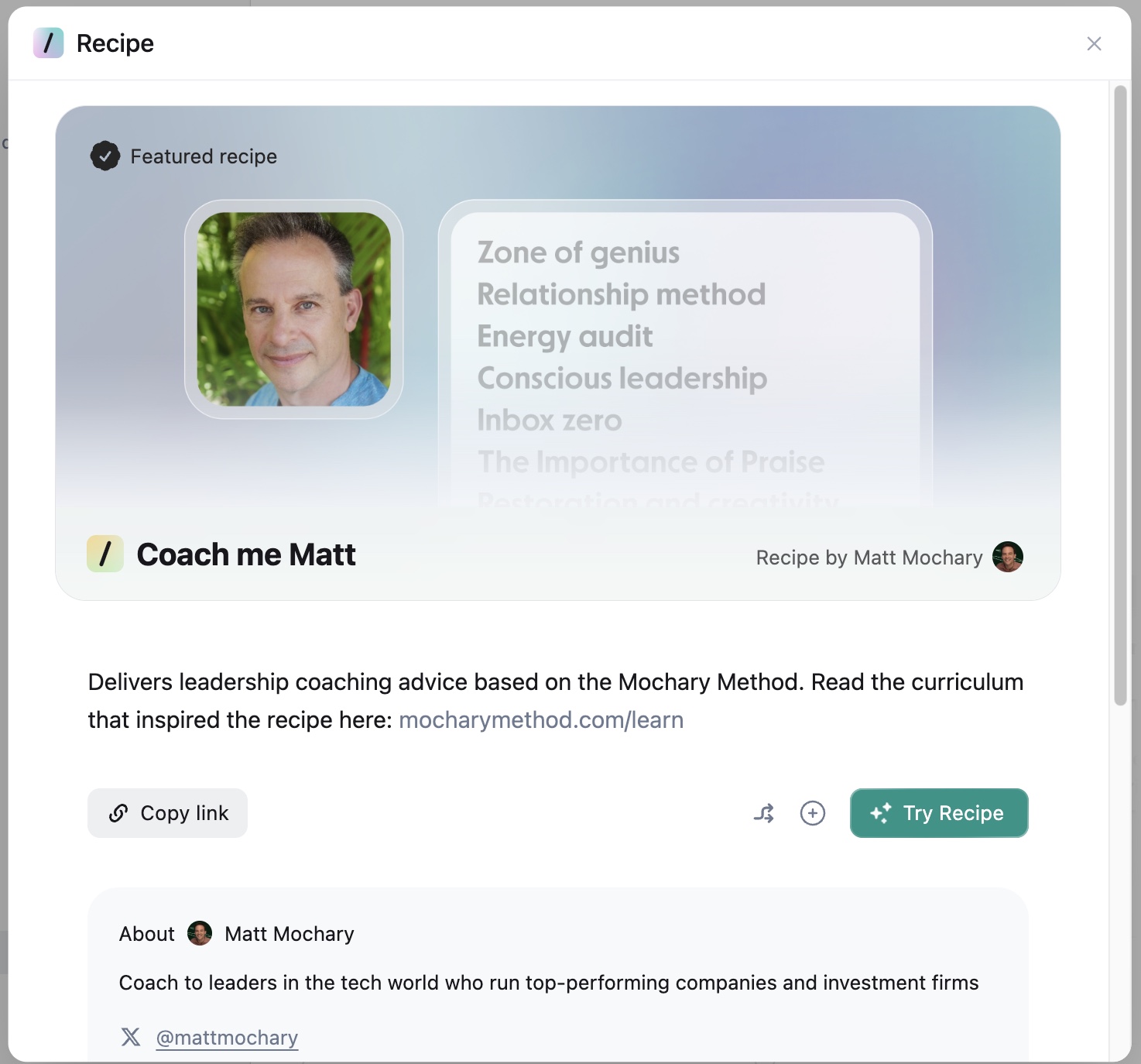
Screen shot of Coach Me Matt Recipe

Having led product teams at Consumer Reports, I can relate to the temptation to add features. I read the Granola.ai product announcement. How did my crush get better? A raft of new features: it wants to be more than my trusty notetaker. It can assume other roles—an assistant to do a first draft, a knowledge archive, and wait, what’s this?  A button/prompt that taunts me: “Coach Me Matt.” Not a real person mind you, just a new “recipe” and a reminder that the AI that’s been lurking and listening in all of my meetings.

In life, in addition to being an unapologetic incrementalist, I also believe in tasting and trying new things. Just a taste. Maybe I’ll like it. I’ll learn something, about the thing and myself. I’ll try it. Once, to know—to decide. So sure, Matt, Coach me.

This coach? Not what I expected, wanted or need.

Matt doesn’t quite want to put me on a performance improvement plan but he thinks that I’m spending too much time in my “Zone of Competence” and not enough time in my “Zone of Awesome.” On Matt’s long list: I’m doing too much “firefighting disguised as strategic work.” I need to do an energy audit and clear my calendar for three days to work on what really matters. Clearly, Matt thinks my priorities are not in order.

I find this coaching session disconcerting. I feel a pit in my stomach and uneasy.  Like some AI experiments I’ve conducted, I find myself suffering from something I’ve taken to calling AI whiplash. Like I’ve stopped short. I’m shaken. I know this feeling all too well—it’s the “I’m in trouble/I didn’t do my homework” script honed in grade and high school. The last time I had feelings this intense was when I asked NotebookLM to look at a collection of digital journal entries and then listened to a podcast summary. People, if you ever want to be humbled this is a good recipe. It’s a bit like being at your own funeral except that your anxious inner voice is providing the eulogy. Skip it and ask a friend about how they experience you instead.

So here’s what I find so creepy about this seemingly innocuous flip and product “upgrade.”  A notetaking tool with one purpose,shape shifted into a surveillance tool without my knowledge or consent. I know, I didn’t have to use this feature, but I thought it was “just notes.” Well, little did I know that “Matt” or Granola were making notes on my performance.

And then my mind starts roaming—what happens when these tools are everywhere? Reading every text message, every post, every email. I can’t help it, but here it comes:

Every breath you take, every move you make, I’ll be watching you.” – The Police.

That song, it’s about a stalker.

What’s even more worrisome? I am not sure we’ll be able to opt out of this surveillance. We’ve all been co-opted into the great digital panopticon. Am I making it up? Well, Larry Ellison, Chairman of Oracle,  a massive tech business with large government contracts opined: citizens will be on their best behavior’ amid nonstop recording. I can’t say this makes me feel good about Oracle’s potential investment in TikTok.

I do 99% of my journaling in a spiral bound notebook with a pen—which these days seems like it may be the only way to escape the prying eyes and ears of the technology that surrounds and envelops us.

The irony? I did get critical feedback on this post from Claude.ai The difference? I asked for it—which means personal agency. I asked Claude.ai to catch my errors and offer suggestions. I constrained the project input and the parameters—for now.  I hope Anthropic keeps this sensibility as Claude’s capabilities grow.

Am I giving too much away?

My crush, well, as Aimee Mann, “it’s not what, you thought when you first began it. And it’s not going to stop until you wise up.”

What do you think? Have you had a moment when using an AI tool turned into something darker? Share it in the comments!

Unapologetic Incrementalism

“Yesterday I was clever, so I wanted to change the world. Today, I am wise, so I have to change myself.” 

– Rumi, quoted in Colum McCann’s Apeirogon

When overwhelmed by world or life events, which is often, I return again and again to Voltaire’s Candide.  How can something written by a Frenchman a couple hundred years ago make me laugh today? Why do I think it’s instructive for me, and maybe for us now? 

The world that Voltaire chronicles in Candide is truly terrible. War, sickness, pestilence, earthquakes, fires, swindlers, pirates. He was making fun of Leibniz, represented by the absurdly optimistic Dr. Pangloss, who can always come up with some reason why this is the best of all possible worlds.Book cover of Voltaire's Candide

Candide worships Pangloss at the start—the best philosopher in all of Westphalia! Candide is charmingly naive, though his worship of Dr. Pangloss, like his love of Miss Cunégonde, is sincere.

But the events of the world, with the help of a very different philosopher, Martin, challenge Candide’s views. Martin, a disillusioned and pessimistic poor scholar, helps Candide realize that things may not be all for the best. Appearances can be deceiving. Goodness as well as evil lurks in the heart of every person. Misfortune is universal. What seems like virtue may be vice. Virtue may be a mask for greed, vanity, or self-interest. Holding a high office does not confer morality. Martin’s blunt assessments sow seeds of doubt in Candide’s optimistic worldview.

Voltaire would have thrived as a satirist today. If I were to complain to a fictional Martin I imagine he’d reply, “of course it’s so—haven’t you been listening? Why would you expect anything to change?” But our hero doesn’t adopt Martin’s pessimism. Instead, Candide is transformed after visiting a humble Muslim farmer whose family works together to tend theirFlowers blooming in a Brooklyn tree pit orange grove, eat candied citrons, and ignores the constant political upheaval. Yet Candide resists Martin’s pragmatic doom and gloom settling instead on the farmer’s lived experience. 

From this experience, at the conclusion of one of Dr. Pangloss’s soliloquies, Candide stops him. Work, he concludes, is the only reasonable response. We must cultivate our garden—in the case of his crew, this is a literal garden. Everyone pursues what they’re good at: carpentry, pastries, philosophizing. Like the modest farmer, they have enough, but there’s no scheme to transform the world.

Voltaire’s garden embraces practical, grounded wisdom. We might not be able to change everything, but we can tend to the things around us and make them better with work. When I look around, I see gardens everywhere—whether it’s a well-tended tree pit on my block bursting with flowers, or a store where the proprietor has lovingly collected every manner of notebook, faith-based congregations that look after people in its vicinity as well as its congregants.  

I have taken to calling this approach unapologetic incrementalism. I may not have time for a long bike ride, but I can ride to work. The recipe calls for thyme but I only have oregano? It will probably work. Julia Child, who said ‘the only real stumbling block is fear of failure. In cooking you’ve got to have a what-the-hell attitude,’ was an unapologetic incrementalist. So was Voltaire.”

The question Voltaire leaves us with isn’t whether this is the best of all possible worlds, but whether we’ll choose the practical wisdom of tending what’s in front of us over the ambition of fixing everything or spending time on an overarching theory that explains it all. Not sure? Begin. Make it part way, and then come back again tomorrow, and the day after that…

Note: Neville Jason’s Audio narration of Voltaire’s Candide is excellent and the Norton Critical edition’s text comes with helpful essays. The text is short, the lessons are large. 

Showing Up for One Another

Part of the reason I keep coming back to Quaker meeting is that I never know what I am going to get. There are some things that are certain. I know that there will be a defined starting time. I know that we will sit together in silence for about an hour. What I don’t know is that if anyone will speak or what they will say. In a Quaker context, I also don’t know what I, or our community is going to be called upon to give. Depending upon your point of view this could either be a bug or a feature. For me, it’s definitely a feature.

This stands in stark contrast to my Catholic upbringing where I could walk into church and know the recipe:  First Reading, Second Reading, the Gospel, the Homily, Profession of Faith, Lords Prayer, Communion, Final Blessing. Go in Peace! I know this nourishes many and can be perfectly satisfying but it was too predictable for me. I don’t want to know the spoilers. I want to feel like I am helping craft the plot.

Quaker meeting began for me as a physical place—the understated Brooklyn Friends Meeting House; floor to ceiling windows, lots of light streaming in, benches that face one another and therefore we face each other. The idea is that you sit and listen in silence. I am not the kind of person who excels at sitting still for very long; a few minutes seem like an eternity. This restlessness did not help my academic performance in primary or secondary school, which could be described as mediocre at best but did improve with the autonomy of college. Fast forward to the late 90s and among Quakers, I have learned that I can sit still for a whole hour and even revel in it.

Fast forward to 2020: COVID came. The Meetinghouse was closed. I tried going to a Zoom meeting at 11am with many other Friends from Brooklyn and beyond but it felt a bit too much like the all-staff town hall meetings. Screen after screen of faces, many of them peaceful, everyone connected in their homes. It felt too much like work until I learned about a smaller Zoom at 9am. I could get back from my run, go to Meeting, and be done by 10— all before anyone else in my house was even awake. So the lovely facing benches were replaced with a single screen of anywhere from 8 to 14 faces on any given Sunday. But this meeting was different. We always ended about 15 minutes early and then everyone would check in—how are you doing? What’s going on in your world?

Folks weren’t shy. We would share good things: the sense of solidarity we felt when we went out to bang on pots and pans to thank essential workers, a sourdough culture that was flourishing, progress on picking a neglected hobby back up. But we were just as likely to share things that we were struggling with—a kid at home who wasn’t thriving in zoom school, missing relatives who we feared to visit lest we leave them with a case of COVID, or that we really weren’t doing that well at all.

Though the pandemic has come and gone this group continues to meet at 9am every Sunday on Zoom and I always leave inspired. This past Sunday I learned that St. Theresa favored small acts over radical martyrdom. Another friend shared that feelings of anxiety and dread are rarely prophetic. Another friend talked about how caregiving benefits both the receiver of the care and the giver.

These messages remind me of themes from Sharon Salzberg’s Real Life. Salzberg is an American Buddhist Educator. She connects Buddhism to modern psychology. The book is full of practical insights—and a theme that runs though it is the idea of interconnectedness. How do we show up for others who are going through difficult things? Respond to pain with presence. This is what our 9am meeting does.

There is no one minister to go calling on a person who needs help. We coordinate with one another. Some days you’re the one checking in on someone; some days you’re the one being checked in on.

One of the anecdotes Salzberg relays is of a child who was suffering and considered praying. The kid said “I need a God with skin.” The idea is that we can be the Gods with skin. Will you see the humanity in another person, and meet it? So while the messages you might hear are unpredictable what’s certain is that we show up for one another. That’s more than a set of beliefs—it’s a practice we undertake together.

Where can a person go when he doesn’t know where to go? 

Jenny Erpenbeck asks this question of her readers in Go, Went Gone, on a full blank page, repeated again, on another blank page. 

Go, Went, Gone bookcoverGo, Went, Gone is a short novel published in 2015 in Germany, and released in the US in 2017. In it, Erpenbeck tells the story of a group of African refugees protesting at Oranienplatz in Berlin. Richard, a retired, widowed professor, instead of just passing by, starts a conversation with the men in this group. That conversation leads to visits. He learns their names, and befriends Osarobo, Rashid, Ithema, and Karon as they navigate Germany’s cool, seemingly arbitrary and improvised migration system. 

Go, Went, Gone served as a mirror of sorts for me as I do intermittent volunteer work with the New Sanctuary Coalition, (NSC) an NYC based group that ensures that people are present for migrants while they work their way through the US legal system in the hope of continuing their lives here. 

While the lobby of the Ted Weiss Federal building has all of the heavy marble majesty of an early 21st century federal office building, a quick elevator ride leaves visitors in a white antiseptic corridor where schedules for judges with lists of names printed on orange paper line the walls. 

Migrants wait in a room with low ceilings, fluorescent lighting, and immovable chairs. That day, I helped Andi, a minor, update his change of address paperwork, an essential bureaucratic requirement. I waited and watched a judge grant him a court date far in the future so that he could have legal counsel. We had sharpies on hand so that he could write the phone number of a relative on his arm in case his phone was confiscated.  Later that same day, just outside the courthouse, ICE agents placed him in detention. 

The book’s protagonist, Richard, did much more than show up at a court hearing for the migrants he befriended. He visits them in their temporary housing. He learns their stories, about their countries and how they became separated from their families. 

In one scene, Richard takes Itehema to see a lawyer who traces modern German migration law back to Tacitus of Rome. 

“It is accounted to a sin to turn any man away from your door. The host welcomes his guest with the best meal that his means allow. When he is finished entertaining him, the host undertakes a fresh role: he accompanies the guest to the nearest house where further hospitality can be had. It makes no difference that they come uninvited; they are welcome just as warmly. No distinction is ever made between acquaintance and stranger.” 

Erpenbeck challenges us: “[M]ust living in peace – so fervently wished for throughout human history  result in refusing to share it with those seeking refuge, defending it instead, so aggressively that it almost looks like a war?”

Go, Went, Gone, is a fictionalized retelling of how the actions of an individual transform and lift up the lives of others. New Sanctuary Volunteers do that work today in New York City. 

“In the end, we will remember not the words of our enemies, but the silence of our friends.” Martin Luther King, Jr. 

We cannot be silent in this moment. We can show up. Here’s how: 

https://www.newsanctuarynsc.org/get-involved

Get a copy of the book: https://bookshop.org/p/books/go-went-gone-jenny-erpenbeck/12418234  

Tired of scam texts and spam messages? Want more protection? Try Signal.

Too long; didn’t read version: the messaging platform you use on your phone matters–and there’s a better one out there, Signal, that you should download and install today. It’s free, safe, and easy to use. I’m writing this guide because I think we are more vulnerable to scams and surveillance than ever before. I didn’t find up to date guides that made a strong recommendation. Here’s mine:

Why bother? Scams abound; privacy matters 

Have you noticed that hardly a day goes by without some kind of suspicious message popping up on your phone? Here’s one that gave me pause this week: The subject line: “EZ Pass Toll Violation” was well-crafted, and seemed plausible. We have a car. We use EZ Pass. Could this be legitimate? But then I noticed something off: the sender had a +63 country code (Philippines). The link looked shady–not something EZ Pass would use.. However, it came in as an Apple iMessage, which I usually only get from people I know and trust.

Image of a scam text message

EZ pass unpaid…

So I “Delete and Report Spam,” after I exerted some minimal effort to stop, analyze, and decided this was a scam. What if there were a better way? One where these types of messages don’t reach me in the first place?

Messaging Should Be Simple and Safe

Sending short messages is one of the best things we can do with our devices—connecting us with friends and family near and far. The catch? It’s gotten more complicated and a bit riskier. There are countless ways to send messages: SMS, RCS, WhatsApp, Telegram, Facebook Messenger, iMessage. But not all are created equal. While many claim to care about privacy, few actually live up to that promise. Scammers have access 

What’s the big deal about privacy?

You might be thinking, I have nothing to hide. Who would care about me? But privacy isn’t about secrecy—it’s about control. The reality is that scams and fraud thrive in an environment where messages are easily intercepted, spoofed, or tracked.

Traditional SMS messages? They’re not encrypted and can be read by your phone company (or intercepted by hackers). RCS—the so-called “next-generation SMS” for Android? Still not encrypted when sent between Android and iPhone. WhatsApp and Telegram? They encrypt your messages, but they collect data about your conversations—whom you talk to, when, and how often. That’s valuable information that companies might sell or governments might demand.

We deserve better and a solution–and the good news is that the best solution is free, easy to install, and respects your privacy from the start.

Say Hello to Signal 

Signal is a messaging app developed by the non-profit Signal Foundation, built with privacy and security in mind from day one. That’s it. No ads. No tracking. No selling your data. It’s supported by donations from people like me. I chip in $5/month because I believe in its mission of keeping conversations truly private. 

Other apps might keep your messages private, but Signal ensures that even metadata—like who you talk to and when—stays private too. Your contact list isn’t stored. Your messages aren’t stored. Unline WhatsApp, Signal doesn’t even know who you’re messaging. In an age of almost daily data breaches and identity theft, these choices things matter–and Signal is a much better choice. 

Getting Started 

In order to reap these benefits, you need to be on Signal, and so do those that you’re messaging. As more people use Signal we all become safer. It works on all phones and PCs—iPhone, Android, Mac, PCs. It’s easy to download and install:

👉 Go to https://signal.org/download and install it on your phone.
👉 Link it to your phone number (this helps others find you but doesn’t expose your number publicly).
👉 Set up a PIN (this adds an extra layer of security).
👉 Decide whether to share contacts (I do—Signal never stores them, but it checks which of your contacts are on Signal).
👉 Install Signal on your computer (optional but useful).

Why bother? 

With Signal, you can message people, make calls, and join group chats knowing that no one but you and the recipient can read your conversation. If you’re in a group, only members of that group can see those messages. It works just like the messaging applications you already use. If you’re on iMessage or What’s App you already know how to use it. 

In three plus years of use, I’ve never received a scam text on Signal. The only time I’ve gotten a message from someone I didn’t know, I simply declined the request. It’s that easy.

Switching to Signal doesn’t just protect you—it helps protect everyone. The more people who use it, the stronger the network becomes. 

Let me know in the comments if you have any questions! 

Why should you listen to me? I got my first computer in the 1980s when they still had floppy drives and have been using them ever since. I’ve worked in a range of roles that put technology in the service of humans. More recently, I have made digital products for Consumer Reports. I’ve managed to avoid scams (so far) but friends, acquaintances and family members have fallen prey to increasingly sophisticated scams. 

For further reading on scams. 

https://www.consumerreports.org/money/scams-fraud/new-scams-to-watch-out-for-a9334297641/

https://www.consumerreports.org/money/scams-fraud/how-to-protect-yourself-from-scams-and-fraud-a6839928990/ 


sketch of seating at a Quaker Meeting

Why am I a Quaker?

Start with why. That’s the wisdom of Simon Sinek–asking people to sharpen their thinking but his question makes me wonder if he might be a Friend. 

Almost 25 years ago, young and fresh to New York City, I had the good fortune to meet Scott–an attender from Brooklyn Monthly Meeting. After my umpteenth question, and many patient answers, Scott just said, “you know, why don’t you come to meeting sometime?” His  casual invitation changed my life. 

Why? 

I was seeking–a place to fit in, a place to be myself, a place to connect with others. I found it.

Why? 

Well, the idea of “that of God in everyone” seemed right. The stern Catholic tradition of my youth framed it differently. We are all made in God’s image. We have fallen. If we are good, we’ll get into heaven and live forever. The Friendly framing spoke to me–a spark of the divine in me? In everyone? Well, what an animating and useful principle. It spoke, and speaks, to my heart and mind.  

Why? 

Because if we believe that there’s something of the divine in everyone then I am on equal footing with you.  Another pithy message from Bono–another latent friend?  “We are one, but we’re not the same. We get to carry each other.” 

Why? 

We believe in “continuing revelation,” in other words, we favor questions over answers–and the answers that we find are provisional, until we find better answers–together. Not one text. All texts. All people. All voices. 

Why? 

Because we seek in silence–and everyone can be a source of truth–a messenger. We just have to be still and listen. Being still is not easy in today’s modern world of digital tethers, where distractions are a screen away. A Quaker meeting dedicates a time and place for us to sit, and listen–for our own inner voice, and for a message from a friend that might speak to us. 

Why? 

Because I am wary of promises of the next world. I am certain that this one needs our attention–in a way that is consistent with us being  stewards for the generations that will follow us. 

Why? 

Because the problems are bigger than us, but solvable by us. Together we can figure it out. 

Why? 

Because I think that if we all treated one another as though there were something of the divine, then  we’d listen more–we’d care more. This is also a wish for me–I am seeking, and need reminders. 

Why? 

Because I am inspired by what our beliefs have led us to do–whether it was an early renunciation of slavery, or providing relief to those harmed by war–regardless of what side they were on. Because there’s still a vast gap between what we believe and what exists. The Jacksonville shootings of three Black people are a reminder that white supremacy is alive and well. 

Why? 

Because together, Friends, we can work to close that gap, to love one another and build a stronger community. 

Are you a friend? Thinking about it? Why? 

I’m listening. 

Ted Bongiovanni is a member of Brooklyn Monthly Meeting and the Executive Directory of the New York Quarterly Meeting.  This post originally appeared on Spark, the newsletter of the New York Yearly Meeting of the Religious Society of Friends. 

Fish Don’t Exist

I know, you’re thinking, of course fish exist. I have seen fish, smelled them, eaten them, maybe caught them–there is no denying that they exist. Any yet, that’s the title of Lulu Miller’s delightful book, Fish Don’t Exist which tells the story of David Starr Jordan, the founding president of Stanford University, whose mission in life as an ichthyologist was to discover every species of fish–a quest he pursued with zeal, certainty, and rigor. When the great California earthquake shatters the ethanol filled jars. He grabs a needle and thread to start connecting the labels to samples. This is a tale of American grit–or so Miller had me thinking. Yes, I was hooked from the first chapter.

Fish Don't Exist - Book cover

Miller is one of the co-creators of NPR’s marvelous Invisiblia podcast–she approaches Jordan with a journalists restless curiosity but this book is also a personal history and a reflection on our world. She covers chaos theory, reminds us of Voltaire’s critique of optimism, and the dangers of hubris. We follow her on her journey of discovery–both about Jordan and on the importance of meaningful connections. She grapples with our significance in the universe, and champions doubt to temper our impulse to be blind to the world’s complexity and bigness.

Fish Don’t Exist is one of my favorite reads of 2022.  It is one of those books that changed how I see the world and affirmed my faith in doubt.  Aren’t you wondering just a little bit about how it can be possible that fish don’t exist?  Act on that curiosity my friends.